Quick summary: Event sales AI reads each venue enquiry, pulls out the event details and scores the lead against criteria the venue sets, such as date, group size, budget and lead time. It ranks enquiries by value so the team answers the best ones first, and it emails planners to fill in missing details so a proposal can go out sooner.
Most venues bring in event sales AI for two jobs: working out which enquiries deserve attention first, and getting the missing details out of planners so a proposal can be written. Between them they take hours each week, and they rest on calls your team already makes every day about dates and spend.
How well it works depends mostly on the rules you give it. A good scoring model reflects your soft periods and minimum spends, and it gets sharper as you check its scores against the bookings you win.
What is event sales AI?
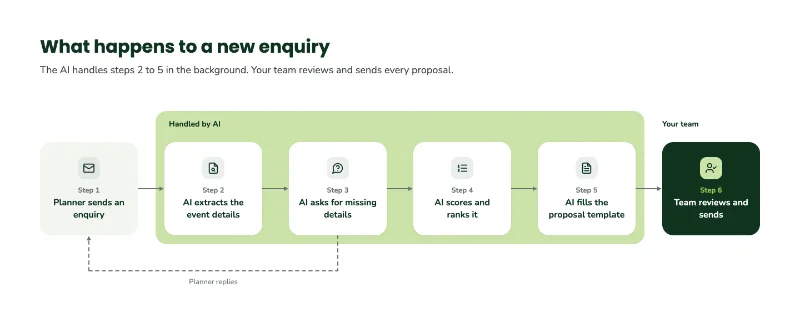
Event sales AI is software that handles the early, repetitive parts of venue sales: reading enquiries, pulling out the event details, scoring each lead and asking planners for anything missing. The better tools run as AI agents inside your existing venue software system, so the sales team starts the day with organised, ranked enquiries.
How does event sales AI score leads?
AI lead scoring works in two steps. First the AI extracts the details from each enquiry, such as date, group size, event type, budget and room needs. Then it checks those details against rules the venue has set, gives each enquiry a score and ranks the list by likely value.
Scoring is the lead qualification step. A model might add points for a date in a soft period, a group that fits one of your rooms well, a budget above your minimum spend or a decision due within a fortnight. It might take points off for a date that's already held or an enquiry with no date at all. The output is a ranked list, and every enquiry is judged by the same rules.
What criteria should venues use to score event enquiries?
Score on whatever predicts revenue and fit at your venue. For most venues that means the event date and how much you need it, group size against your rooms, budget, lead time, event type and how complete the enquiry is. Weight each one to suit your business and review the weights every quarter.
Date and demand. Give soft periods a higher score.
Group size and room fit. Smaller meetings convert at 66%, falling to 34% for groups of 50+. Modest spends can be some of your strongest leads.
Budget or spend per head. If the planner gives a figure, score it against the minimum spend for that space and day.
Lead time. Shorter lead times need faster answers.
Event type. Different events have different margins and sales cycles, so weigh them by what your venue wants more of.
Completeness. Don't score incomplete enquiries at zero. Plenty become good bookings once someone asks the right questions.
How does event sales AI handle follow-up?
AI follow-up happens at two points. Before a proposal, the AI spots missing details such as a date or budget and emails the planner to ask for them. After a proposal, some tools send scheduled reminders. Either way, the aim is to cut the time between an enquiry arriving and the planner getting a useful reply.
For many teams, a lot of the delay sits in the gap-filling stage. A planner may have started a conversation but nobody can quote on it yet. Someone has to reply, ask for a date and budget, wait, then enter the answers. An AI agent can send that reply within minutes and update the record when the planner answers. For event sales AI tools like iVvyAI, the email agent does this job: it reads the enquiry, works out what's needed to qualify and propose, and contacts the planner to fill the gaps.
Follow-up after a proposal needs more care. Some event sales tools and many CRMs can schedule reminders before an option expires, and these help with venue sales automation. Planners at that stage often want to talk to a person, though, so keep post-proposal messages personal and short, and let your team decide when to send them.
What return can a venue expect from AI lead scoring and follow-up?
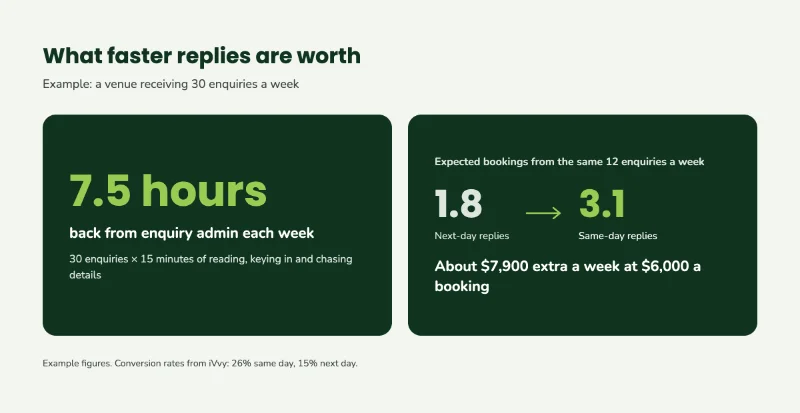
The return comes from two places: hours saved on enquiry admin, and extra bookings from replying sooner. To estimate it, multiply the admin time per enquiry by your weekly volume, then apply the drop in conversion between same-day and next-day replies to the enquiries you currently answer late.
Does AI replace the venue sales team?
No. Event sales AI takes on reading, sorting, data entry and first-round questions, which gives salespeople more time for site visits and the planners who book with them every year. A person should still review every proposal before it goes out, because pricing and tone depend on context the AI may not have.
For a small team, AI adds capacity without adding headcount. The admin hours in the calculation above go back to the people who close bookings. This is what iVvy means when it describes its software as an extra team member.
Human review also protects the relationship. A long-standing client who expects a particular rate, or a planner who had a rough time at last year's event, needs someone who knows the history. Event sales AI tools like iVvyAI is built around this: its data entry agent fills the proposal template, and a person reviews and adjusts it before sending.
How do you measure whether it's working?
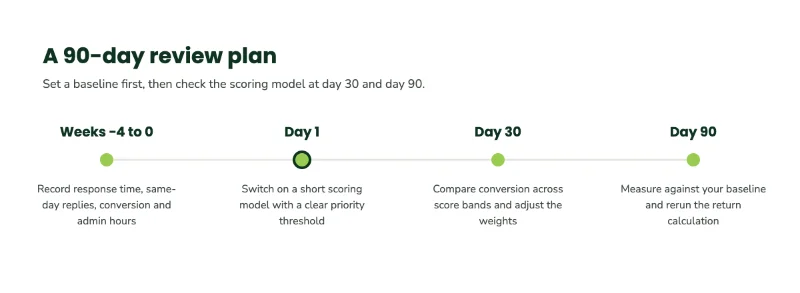
Track a few numbers for a month before you switch it on and for a quarter after: average venue response time, the share of enquiries answered the same day, conversion rate by score band and hours spent on enquiry admin each week. If high-scoring leads don't convert better than low-scoring ones, change the scoring model.
Response time is the easiest to move. Industry research shows 80% of planners say the ideal RFP response time from a hotel or venue is four days or less. Treat four days as the outer limit. Given how quickly conversion drops after the first day, same-day replies are the better target for meetings and events sales.
Conversion by score band tells you whether the model is right. If enquiries scored above 80 convert at much the same rate as those scored 50 to 60, the criteria or weightings need work. Look at the bookings you won from low scores and ask what the model missed.
Keep a note of lost reasons as well. If you're losing high-scoring leads on price or availability, the scoring may be doing its job and the fix sits with pricing or inventory.
Frequently asked questions
Is event sales AI the same as a chatbot?
No. A chatbot answers questions on your website while a planner types. Event sales AI works in the background on enquiries already in your inbox, scoring leads and asking planners for anything missing.
Can a venue change its lead scoring criteria?
It should be able to. Look for a tool where the venue sets the scoring model and qualification rules and can change them at any time, so the scores keep up with seasonal demand and sales targets.
What happens to enquiries with missing information?
The AI finds the gaps, such as a missing date or budget, and emails the planner to ask. Once the planner replies, the enquiry is updated and scored again.
Does event sales AI work with any email provider?
It depends on the tool. Some only connect to certain email platforms. iVvyAI works with any email provider and can read enquiries in multiple languages.
How fast should a venue respond to an event enquiry?
The same day where possible. Planners expect a reply within days, and conversion falls quickly once a reply slips past the first day.