When an event enquiry arrives, the prospect has almost certainly contacted more than one venue. Whoever responds fastest and most professionally has a significant head start before a single site inspection is booked, and most venue sales teams know this, even if their processes tell a different story.
The gap between knowing and doing
The average venue takes 47 hours to respond to an enquiry, yet research shows leads contacted within five minutes are 21 times more likely to convert than those reached after 30 minutes. By the hour mark, many venues are still working from a blank template while the prospect has already received a proposal from somewhere else.
A slow response signals, fairly or not, that working with your venue will feel the same way.
Why venues lose bookings (& how event sales AI can help)
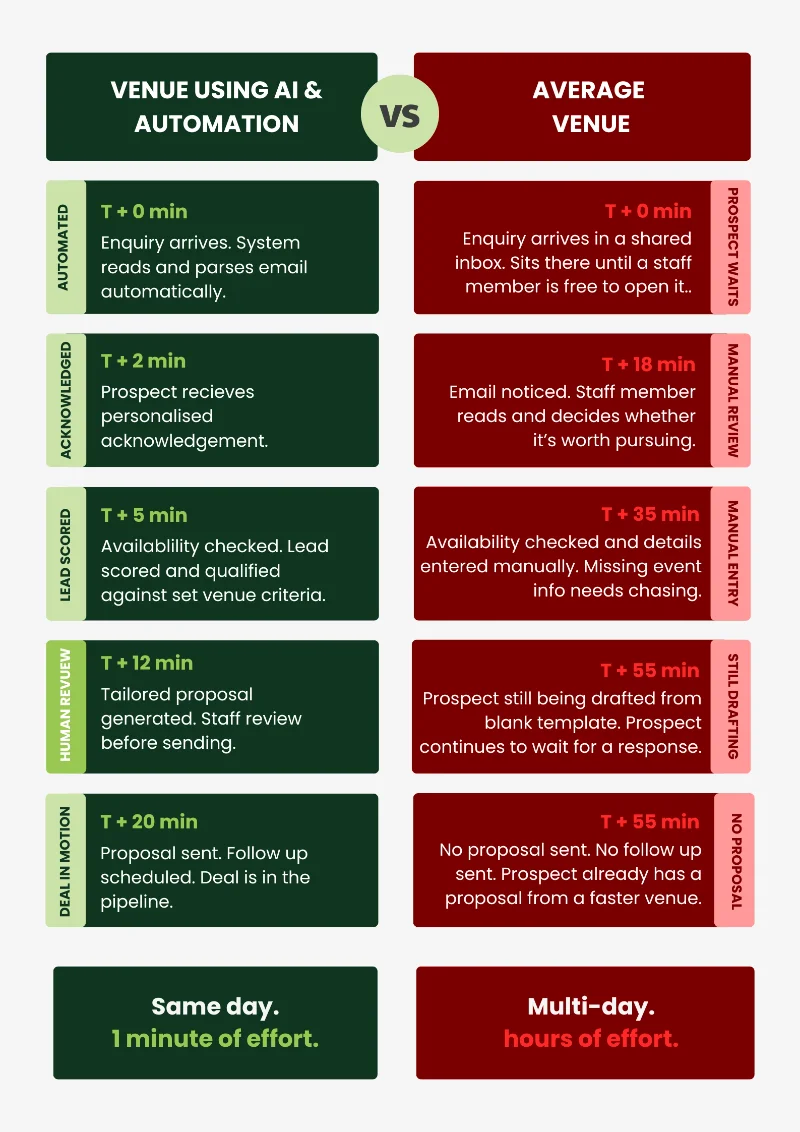
At a venue using event sales AI tools, the enquiry is parsed the moment it arrives. The prospect has a personalised acknowledgement in their inbox within two minutes, the lead has been scored and qualified against your venue criteria by the five-minute mark, and a tailored proposal draft is ready for staff review within 12. 20 minutes in, the proposal is sent, follow-up is scheduled, and the deal is moving, for roughly one minute of staff effort.
At a typical venue, the enquiry sits in a shared inbox until someone is free to open it. That person manually checks availability, chases missing event details, and drafts from a blank template, and after nearly an hour a proposal still has not gone out.
The cost of a slow process
When your team spends hours processing a single enquiry manually, they have less time for the bookings already in progress and are more likely to make errors under pressure, so busy enquiry periods become a grind rather than a growth opportunity.
Event sales AI removes the friction that stops them doing their best work. Staff still review and approve proposals before they go out, but parsing, scoring, and drafting happen in the background without anyone managing them.
Personalisation at speed
A common concern: can automated responses feel personal? It depends on what personalisation means to a prospect.
They do not expect you to have read their mind, just their enquiry. A response that correctly references the event date, guest count, room preference, and catering requirements, sent within two minutes, will feel more attentive than a carefully written reply that arrives three hours later opening with “Thanks for your enquiry.” The bar at first contact is lower than most venue teams assume.
Response time and conversion
Leads contacted within five minutes are significantly more likely to convert than those reached after 30 minutes, and after the one-hour mark the probability drops sharply. For venues, this is amplified by the fact that event planners are often working to tight deadlines. A conference in six weeks, a corporate dinner next month: a same-day proposal keeps you in the running where a next-day response often does not.
Building a process that holds under pressure
Peak periods (the September-October conference rush and end-of-year function season) are where slow processes fail most visibly, with enquiry volume spiking and response times blowing out at the worst possible time.
A well-built enquiry workflow using venue management software with event sales AI performs consistently whether you are handling five enquiries a week or fifty. Automation covers the repeatable steps (acknowledgement, availability check, lead scoring, proposal drafting) while human judgment covers the decisions that need it: pricing exceptions, unusual requirements, accounts where the relationship matters. Venues that grow their events revenue year on year tend to have this balance right, with their sales team focused on converting opportunities rather than processing them.