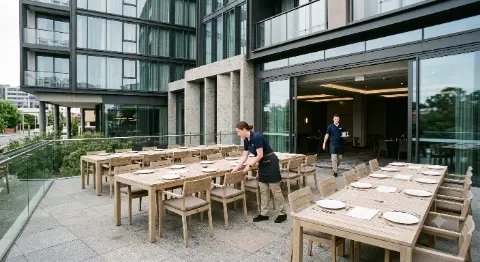
Hotels are competing hard for group & events business. In-person event formats are now the default, with cost being the biggest planning challenge for event planners. For hotels and function centres, demand goes to the properties that can respond faster and price more sharply than their competitors.
That pressure is what has pushed venue management software well past the digital calendar it used to be. In 2026 it's where enquiries land, quotes get built, catering and accommodation come together, invoices go out, and a property’s whole event revenue picture lives. This guide walks through what separates capable venue management software from the tools that just about get by, with an eye on the criteria that matter most to sales leaders: AI, automated invoicing, integrated catering and accommodation, and workflows that connect events to the rest of the hotel.
What makes it hard for hotels to manage venue bookings without software?
Ask any venue sales team what their day looks like without a dedicated system and you’ll hear a familiar list: enquiries scattered across inboxes, availability sitting in a spreadsheet nobody remembered to update, quotes rebuilt from scratch because last month’s template lives on a colleague’s desktop, and contracts chased over email.
Harvard Business Review’s audit of 2,241 companies found that those contacting an inbound lead within an hour were roughly seven times more likely to have a meaningful conversation with a decision-maker than those who waited even an hour longer, and around 60 times more likely than those who left it a full day, yet the average response time landed at 42 hours. A venue enquiry behaves the same way: the property that answers first, with a real proposal, is usually the one that takes the booking.
7x
more likely to qualify a lead when you respond within an hour — against a 42-hour average response time across businesses.
Harvard Business Review, The Short Life of Online Sales Leads (2011)
The manual work behind those responses carries its own price. Deloitte describes a hospitality back office that never caught up with the guest-facing side, where tasks such as payments still lean on spreadsheets, email approvals, and delayed reconciliations. Every one of those workarounds is time a salesperson isn’t spending on live enquiries, and a spot where a figure can quietly go wrong. It is part of why 81% of hoteliers told Deloitte that lifting employee productivity is a priority for the year ahead.
Felix Undeutsch, CEO of hivr.ai, puts the problem more sharply: a reactive “convention sales manager,” he argues, “should actually be called a convention admin manager,” because most of the team’s time goes on repetitive manual work rather than the relationships they got into the business for.
Then there’s the risk of things slipping through the cracks. Double bookings happen when two salespeople hold the same space without seeing each other’s pipeline, enquiries go cold because no one owned the follow-up, and revenue leaks through under-priced packages and forgotten upsells. A central function diary and live availability remove most of these failure points, because everyone works from the same real-time view of what’s booked, what’s held, and what’s still open.
Why do hotels struggle with venue management software adoption?
Buying the software is the easy part. Getting a team to use it well is where hotels often stall, and a big reason is where many properties are starting from. Deloitte describes hotels as frequently trapped in fragmented tech stacks that limit their ability to deliver a joined-up experience, and nearly half of hoteliers now name integrating AI-powered tools among their priority technology initiatives for the year, a sign of how much ground there is to make up.
Against that backdrop, a few reasons for slow adoption come up again and again. Turnover is high in hospitality, so a platform that takes weeks to learn loses value every time a salesperson leaves. Event teams are protective of the personal relationships that win repeat business, and there’s a real worry that automation — AI-enabled management tools in particular — will make guest interactions feel generic. When a property already juggles several systems that don’t talk to each other, any new tool can feel like one more login rather than a replacement for the pile.
"Every role that sits 80 to 90% in front of a computer is really at risk. Hospitality is quite the opposite — it’s about hosting people."
Felix Undeutsch — CEO, hivr.ai
Adoption tends to succeed when the software earns its place quickly. That means an interface people can pick up without a manual, onboarding and training that gets new staff productive in days, and support that answers when something breaks mid-event rather than the next business day. Cloud-based access matters too, since sales and operations rarely sit at the same desk, or even in the same building.
For questions posed around AI for venues, Deloitte’s analysts are clear that however capable the technology becomes, some hospitality moments will always be wanted from a person. The better venue software options use automation to clear the admin and give staff more time for exactly those moments.
How do venue management software platforms automate quotes and invoices?
Two of the most time-consuming jobs in venue sales — putting together a quote and getting paid for the event afterwards — are also two of the easiest to automate well.
On the quoting side, good platforms hold reusable templates for proposals, contracts, and pricing, so a salesperson builds a polished, on-brand document by selecting spaces, packages, and dates instead of typing it out each time. The newer generation goes further. AI-powered proposal tools can draft an accurate, branded proposal in minutes from the details of an enquiry, which is what lets some teams answer the same day rather than days late. E-signature contracts then close the loop without anyone printing or posting a thing.
One booking, first enquiry to final invoice
Enquiry → Proposal → Contract → BEO → Event → Invoice |
|---|
Automated invoicing works from the same booking data. Once an event is confirmed and delivered, the system generates the invoice from what was booked, applies deposits and payment schedules, and sends it without anyone rekeying figures from one screen into another.
Online payment collection sits alongside it, so clients can pay by card against the invoice and reminders go out on their own instead of a coordinator chasing them. Handling payments inside the platform also brings PCI-DSS compliance in-house and saves real time on every booking.
Which venue management software handles bookings, catering, and accommodation together?
This is where hotels and conference centres have needs that generic hotel booking systems and standalone event tools rarely meet on their own. A conference booking seldom stops at the room. It comes with a catering order, AV and equipment, sometimes a block of guest rooms, and a bill that has to reconcile all of it.
Integrated catering and accommodation is the difference between one coherent booking and several disconnected ones. When catering lives in the same system as the space booking, menus, dietary requirements, and banquet event orders update in real time as the event changes, and the kitchen works from the same version everyone else can see. That coherence protects revenue, as well as service standards.
9.5% + 7.9%
growth in hotel public room rental and service-charge revenue through 2025, as catering and meeting teams enforced charges more consistently.
CBRE, Hotel Food and Beverage – A Bright Spot in 2025
Accommodation is handled through integration with the property management system. Rather than re-entering room blocks in two places, the venue platform syncs with the PMS so room inventory, guest profiles, and billing stay consistent across departments. Depth counts as much as breadth. A two-way sync that updates room-block status and guest data in real time is a different proposition from a one-way feed. iVvy, for instance, integrates with a range of PMS platforms including Agilysys, Infor, Mews, Opera and Opera Cloud, RMS, and StayNTouch, which gives most hotel groups a path to link their existing accommodation system rather than rip it out.
For groups running several sites, the same logic extends upward. Multi-property venue management and conference center management work best when every site’s diary, pipeline, and reporting roll into one view, so a regional sales leader can read performance across the whole portfolio without collecting spreadsheets from each location.
A quick buyer’s checklist: venue management software for hotels
What to look for | Why it matters |
Live availability & function diary | Removes double bookings and lets teams respond while the enquiry is still warm. |
Templated quotes & e-sign | On-brand proposals in minutes, signed without printing. |
Automated invoicing & payments | Bills built from the booking record; card payments and reminders handled in-platform, PCI-DSS compliant. |
Integrated catering & accommodation | Menus, BEOs, and room blocks stay in sync so nothing falls between departments. |
Two-way PMS integration | Room-block status and guest data update in real time, not via a one-way feed. |
AI that assists | Drafts proposals, scores enquiries, forecasts demand — clearing admin, not the relationship. |
Real-time reporting | Conversion, revenue, and space utilisation visible across every site. |
Security standards | ISO 27001 and PCI-DSS as a baseline. |
What is the best AI-enabled venue management software platform for hotels?
“Best” depends on the property, but the platforms worth shortlisting in 2026 tend to share the same foundations.
AI is the clearest dividing line, and adoption is already well underway. About half of meeting professionals told Amex GBT they are now using AI in how they plan and run events, and nearly half of hoteliers put integrating AI-powered tools among their priority tech initiatives (Deloitte). The most useful implementations behave less like a chatbot bolted on the side and more like an extra team member — drafting proposals, scoring which enquiries are most likely to convert, forecasting demand across spaces, and flagging lost business worth recovering. That kind of AI shortens the sales cycle and sharpens pricing while keeping the relationship in the salesperson’s hands, which matches what the research keeps finding: automation earns its keep by clearing admin, and the human touch still closes the event.
"“People, at the end of the day, do business with people they like, they trust and they can relate to. AI is purely for transactional, informative data points. When it comes to planning the experience, it is exactly about the human touch — something AI will never replace.”
Felix Undeutsch — CEO, hivr.ai
Beyond AI, the strongest venue management software for hotels bring the whole workflow into one place, from first enquiry through proposal, contract, BEO, event delivery, and final invoice, with catering and accommodation connected rather than stitched together after the fact. They integrate widely with the systems a hotel already runs, report in real time so leaders can watch conversion rates, revenue, and space utilisation as bookings move, and treat security as a standard to meet rather than a promise to make.
Keep reading - 6 smart upselling techniques using hotel MICE software
Learn how to create tailored upsells that event clients won't be able to resist. We’ve got six smart upselling techniques that can transform your hotel's approach to service (and selling)
Read here
Frequently asked questions
What is venue management software?
Venue management software runs the events and functions side of a hotel or conference centre, from the first enquiry through quoting, contracts, catering, accommodation, event delivery, and the final invoice. It replaces the mix of spreadsheets, email threads, and disconnected calendars that many venues still rely on with one shared, real-time view of bookings and availability.
How is it different from a PMS or hotel booking system?
A property management system handles guest accommodation — room inventory, reservations, check-in, and billing. Venue management software handles the meetings and events business: function spaces, catering, equipment, proposals, and BEOs. The two work best connected, so a conference booking with a room block stays consistent across both without anyone re-entering data.
Can one platform handle bookings, catering, and accommodation together?
Yes, and integrated catering and accommodation is one of the main reasons hotels move to dedicated software. When catering and space bookings live in the same system, menus and BEOs update in real time as the event changes, while integration with the PMS keeps room blocks and guest data in sync across departments.
Does venue management software handle automated invoicing?
Most capable platforms do. Automated invoicing generates the bill from the confirmed booking, applies deposits and payment schedules, and collects online payments without a coordinator rekeying figures or chasing clients. This often saves close to ten minutes on every booking and keeps payment handling PCI-DSS compliant.
How does AI help with venue management?
AI-enabled management tools can draft on-brand proposals in minutes, score which enquiries are most likely to convert, forecast demand across spaces, and flag lost business worth recovering. The aim is to remove admin and speed up responses while leaving the personal relationships that win repeat event business in the salesperson’s hands.
How long does it take a team to adopt?
Adoption depends more on ease of use and support than on the length of the feature list. Software with a clean interface, structured onboarding and training, and responsive human support tends to get sales teams productive within days, which matters in an industry where staff turnover runs high.
Sources
1. American Express Global Business Travel (Amex GBT), 2026 Global Meetings & Events Forecast (2025). amexglobalbusinesstravel.com
2. Harvard Business Review, The Short Life of Online Sales Leads, Oldroyd, McElheran & Elkington (March 2011). hbr.org
3. Deloitte, Future of Hospitality and related hospitality technology research (2026). deloitte.com
4. CBRE, Hotel Food and Beverage – A Bright Spot in 2025 (2025). cbre.com