Corporate event buyers are already setting their 2027 plans, and the briefs reaching venue inboxes are starting to change. Budgets are going to fewer, better-chosen events, and planners have to show their leadership teams what each one delivered.
Check out the trends most likely to shape meetings and events in 2027, and what each one means for venue sales and events teams.
What are the biggest meeting and event trends 2027 is bringing to the industry?
The biggest meeting and event trends for 2027 are tighter control of event spend, pressure to prove business value, AI that has to show a return, and resilience planning for geopolitical and climate risk. For venues, that means planners will ask for faster answers and clearer data, along with more room to change dates and numbers late.
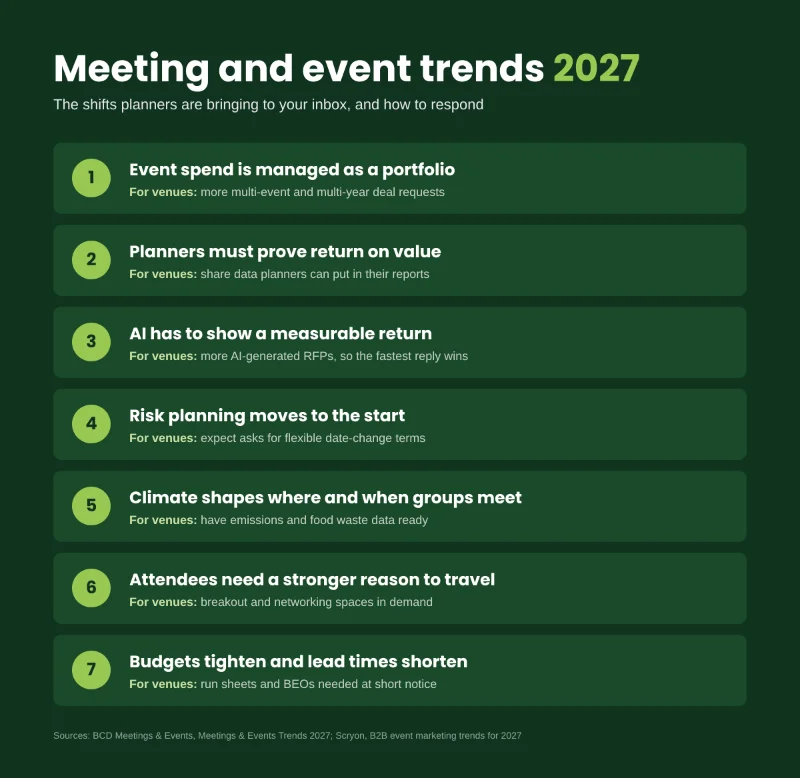
1. Event spend is managed as a portfolio
In 2027, more organisations will manage meetings and events as one connected portfolio, moving budget toward the events that do the most for the business. Many will protect flagship events while cutting lower-value activity, and use the scale of their whole program to negotiate better rates.
What it means for venues: expect fewer one-off enquiries and more talks about multi-event or multi-year agreements. In the UK, procurement teams are expected to push for fixed-rate deals over several years. Venues that can quote quickly across multiple dates and properties will be easier to shortlist.
2. Planners must prove return on value
Planners will be asked to show what an event achieved for the business, with attendance as a starting point. This is often called return on value (ROV), and one industry study found more than a third of buyers struggle to demonstrate it.
What it means for venues: planners need numbers they can put in a report. Final attendee counts, spend broken down by category and clean invoices make their ROV case easier to build, and give them a reason to book with you again.
3. AI has to show a measurable return
AI in events is moving from trials to tools that save time, with human oversight. Watch for agentic flooding: staff and attendees using AI to generate far more requests.
What it means for venues: if planners use AI to send RFPs to more venues at once, enquiry volume rises while the odds of winning each one fall. Response time will carry more weight when a planner is comparing a dozen quotes. For faster responses, venues should consider implementing AI venue tools.
4. Risk planning moves to the start of the process
Geopolitical disruption, extreme weather and changing entry rules mean risk can no longer be left to the end of planning. A GBTA poll in April 2026 found 76% of buyers said geopolitical conflict was affecting travel and meetings decisions, and 56% had changed their meetings or events strategy in the previous three months.
What it means for venues: expect more requests for flexible cancellation and date-change terms, plus questions about contingency plans. Live availability across all your spaces makes it faster to offer a workable alternative when a group needs to move.
5. Climate and sustainability shape where and when groups meet
Climate is now a core planning variable because heat, severe weather and resource pressure now affect attendee welfare and event continuity. Sustainability is shifting from statements to data that informs decisions, including a "value for carbon" test of whether an event's outcomes justify its emissions.
What it means for venues: have emissions and food waste data ready to share in RFP responses, along with your plans for seasonal heat or storms. Venues that make this easy to find will save planners time at the shortlisting stage.
6. Attendees need a stronger reason to travel
With content easy to find online, people will travel for access to experts, peers and decision-makers, and for real interaction. In-person remains the dominant format, with 95% of organisations still running physical events.
What it means for venues: breakout rooms, flexible layouts and spaces for informal networking will be in demand. Accurate room configurations and capacities in your proposals help planners design agendas with interaction built in.
7. Budgets stay tight and lead times get shorter
Most regions expect flat or tightly managed budgets in 2027. In North America, planners are expected to be asked to do more with less, the UK faces weak economic growth and closer scrutiny of third-party spend, and LATAM expects shorter lead times as organisations keep their options open.
What it means for venues: short-lead events need run sheets and BEOs that come together fast.
How will 2027 event trends differ by region?
Region | 2027 outlook | What planners will watch |
|---|
Asia Pacific | Strong variation between premium hubs such as Singapore and fast-growing markets, with India and China leading growth | Air travel costs and food waste at banquets |
Europe, the Middle East, and Africa | Demand holds up, led by life sciences, but conditions are uneven | Middle East instability and EU rules on AI and data |
Latin America | Cautiously positive, with Mexico, Brazil and Colombia central | Shorter lead times, economic and political uncertainty |
North America | Stable demand with flat budgets for many | Operating costs and visa policy for international groups |
United Kingdom | Resilient events, weak economic growth | Justifying premium spend and limited luxury supply in London |
How can venues prepare for 2027 event trends?
Cut response times. With AI pushing up RFP volumes, the first to respond often wins.
Package for portfolio buyers with multi-event and fixed-rate multi-year options.
Keep availability live across every space so you can offer an alternative when dates move.
Have your data ready so planners can report on value.
Frequently asked questions
What are the top event industry trends for 2027?
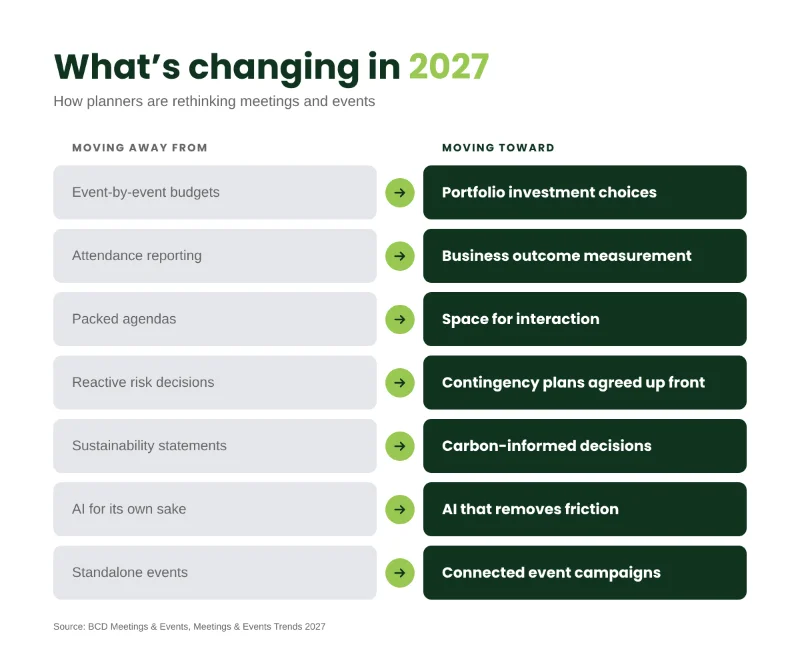
The top event industry trends for 2027 are managing events as a portfolio, proving return on value, using AI with measurable outcomes, building resilience into planning, treating climate as a planning factor, designing for interaction and working with tighter budgets and shorter lead times.
Will in-person events still matter in 2027?
Yes. In-person remains the dominant format, with 95% of organisations still running physical events according to industry research. Organisations are becoming more selective about which events they run and expect stronger evidence of business impact from each one.
How will AI change meetings and events in 2027?
AI will be used more for behind-the-scenes work such as data analysis, search, translation and routing enquiries, with human review on decisions. Organisations will look harder at AI costs and at whether tools reduce work or move it elsewhere. Venues should expect more AI-generated RFPs.
What is return on value (ROV) for events?
Return on value (ROV) measures what an event contributes to the business beyond direct revenue. BCD Meetings & Events groups it into five areas: financial, strategic, experience, governance and relationship value.
What are MICE trends for 2027?
MICE (meetings, incentives, conferences and exhibitions) trends for 2027 include growth in incentive travel built around local experiences and rising interest in emerging destinations such as Phu Quoc, Panama City, Bilbao and Bath.
Sources
BCD Meetings & Events, Meetings & Events Trends 2027 (10th edition, 2026)
Scryon, B2B event marketing trends for 2027 (October 2026)
Cvent, Event-led growth findings, 2026
IDC, 2026 sponsor survey analysis
Oniva, B2B event management survey 2026
Global Business Travel Association, industry sentiment poll, April 2026
Events Industry Council and Oxford Economics, Global Economic Significance of Business Events (2026)